
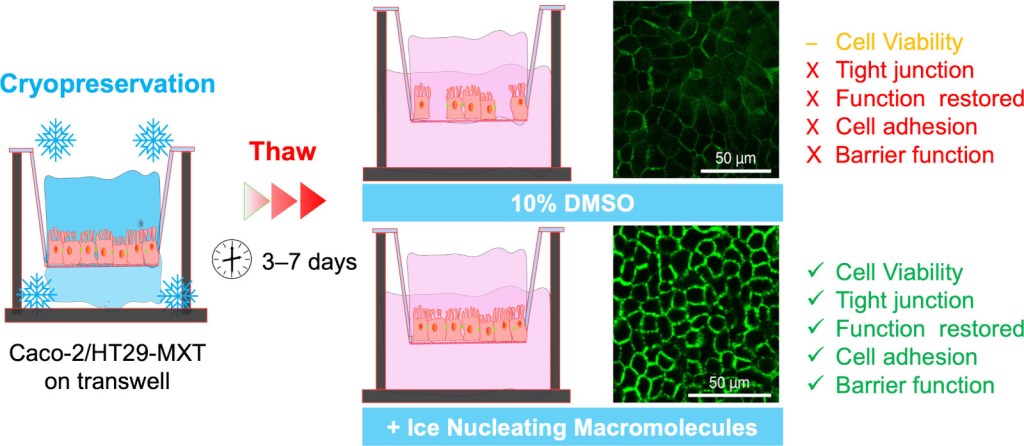
We have been developing the field of ‘chemical cryobiology’, to develop and discover new tools to allow the cryopreservation of biologics. We have a particular interest in cryopreserving complex cellular models, which can be used as alternatives to animal testing but are not available ‘off the shelf’, relying on complex cell culture. In this latest work, published in ACS Applied Materials and Interfaces, we show we can cryopreserve Caco-2 monolayers. Caco-2 cells are an important model for epithelial barriers (e.g intestinal) and important in toxicology. However, current cryopreservation methods recover the cells, but NOT the tight-functions between cells which are crucial for their barrier function. To solve this problem we used chemically-induced ice nucleation to prevent supercooling. Using this, our frozen caco-2 monolayers re-establish their barrier function <7 days post thaw, compared to >20 days if you were to use conventionally cryopreserved cells. We feel this technology will help accelerate the use of more complex cell models. Read the paper here:

 Welcome to the GibsonGroup