
We’re always interested in hearing from motivated candidates with a background in synthetic organic chemistry, polymer chemistry, biochemistry, cell biology, materials or related fields. All our projects are multi-disciplinary, offering excellent opportunities to work with National/International collaborators and world-class facilities.
Specific projects will be listed here when they are available.
Speculative enquires are welcome, email Prof. Matthew Gibson directly if you have any questions including a 2 page (MAX) CV: matt.gibson@manchester.ac.uk
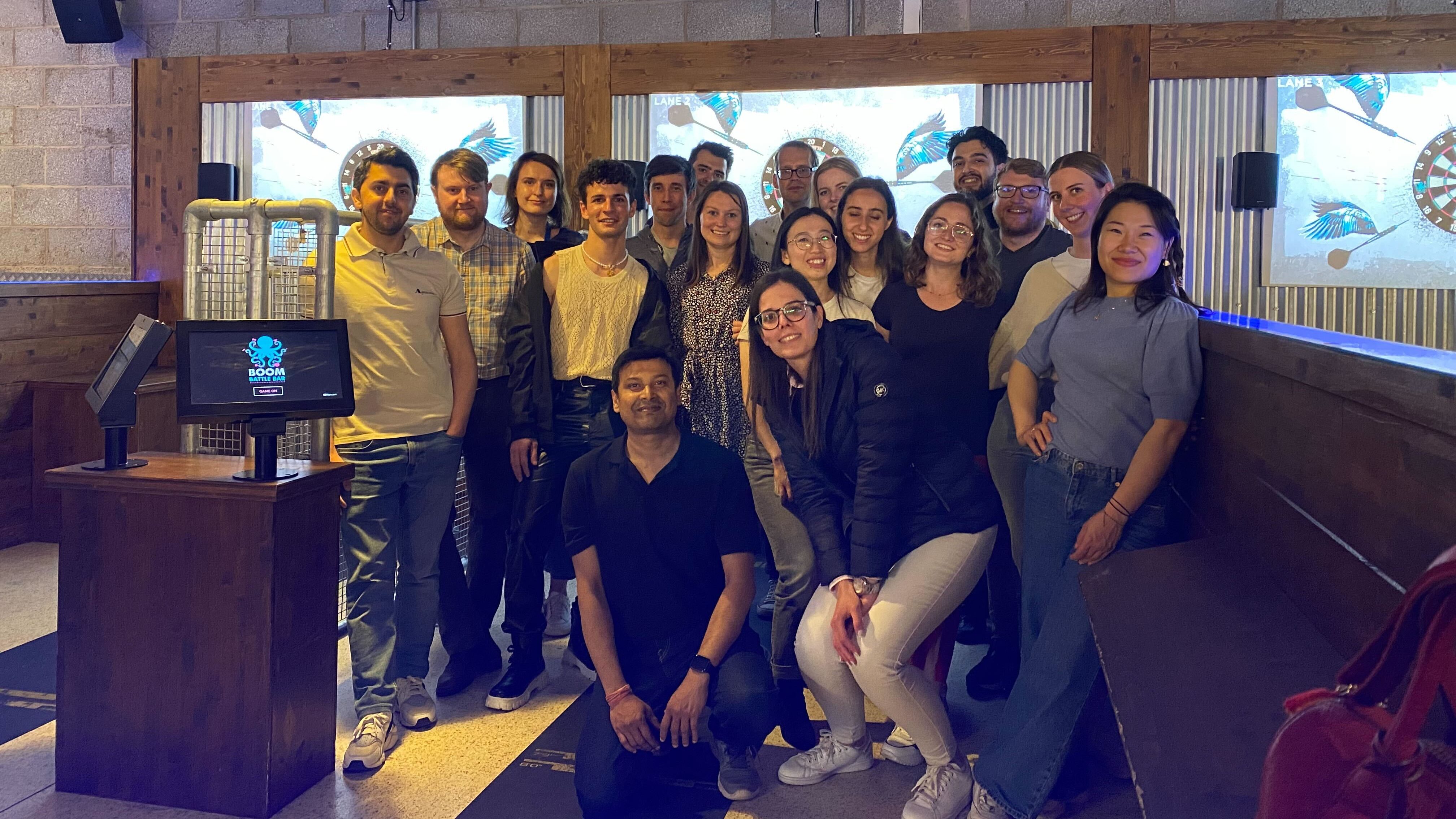
The Team. Summer 2023
Postdoctoral Vacancies .
Contact Prof Gibson for details or to send 2 page CV to enquire
Newton International Fellowships
For non-UK based individuals wanting to conduct research in our team. Annual deadline. 2024 is closed. Read full application details at this link and contact Prof Gibson as soon as possible.
Marie Curie Fellowships
Must be based outside of the UK. Highly competitive scheme and must be committed to application process. Deadline is September each yearWe can support applicants and provide world-class environment. Particularly interest in candidate interested in glycan-based materials to use our new automated glycan synthesis platform.
PhD Vacancies
Scholarship or self-funded applications should contact Professor Gibson directly
[Nationality limits. Non-UK applicants *might* not be eligible for full funding]. Self-funded students should contact MIG.
PhD 1. Development of Biomaterials for Selective Metal Recovery and Remediation
This exciting, interdisciplinary PhD project will take inspiration from extremophile organisms (such as those that live in ocean hot vents, or sub-zero mountain ranges) to develop new polymers for the selective extraction, purification and valorisation of both precious metals, but also to recover toxic metal waste, such as that from the nuclear industry. We will both improve the recovery and replace the currently unsustainable solid-phase extraction systems, making broad impact.
Full Details and application here.
PhD 2. Cryopreservation of T-cells for improved transport and Therapy
This PhD is co-funded by an industrial partner, giving a unique opportunity to use fundamental science, and to apply to a real-world problem. The focus of this work will be to overcome the currently limitations of the cryopreservation of cells used in biotechnology (such as drug production). Conventional cryopreservation with DMSO is inefficient and leads to slow post-thaw deployment of these cells. We will solve this by taking inspiration from natural macromolecular cryoprotectants (ice binding proteins) to both understand why the cells suffer post-thaw, but to also improve and scale the process.
This PhD is not yet open for applications, but interested students should contact professor Gibson directly including a 2 page (max) CV.
Full details and how to apply are here.
PhD 3. Polymers to extract and stabilise membrane proteins
20 – 30 % of all human proteins are classed as membrane proteins (as opposed to soluble proteins). The study of membrane proteins (for drug discovery for example) is complicated by their low solubility making them hard to produce and extract. To overcome this, nanodisc forming polymers- most famously those based on styrene/maleic anhydride (SMALPS)- have emerged to solubilise and stabilise the membrane proteins and their lipids. This project will seek to improve the performance of these polymers so that they extract more protein, faster, and to be more tolerant to different buffers and salts. This will be achieved by using modern synthetic polymer chemistry (such as controlled radical and/or ring opening polymerization), including high-throughput tools alongside protein biochemistry.
Ice binding proteins are produced by diverse organisms as a strategy to survive in the world’s coldest places. Materials which can replicate desirable properties of ice binding proteins could have application in a range of biotechnological areas. This project will use new synthetic methodologies developed by the Lu group to obtain branched polypeptides and collaborate with the Gibson Group to evaluate their ice-binding function. In particular, we will explore high-throughput and automated methodologies to accelerate access to these materials to extract structure-function properties not accessible by established technologies.
See advert link for full eligibility requirements. Candidate MUST spend 2 years at Peking and 2 at Manchester.
Self funders or scholarship holders should contact MIG directly.
 Welcome to the GibsonGroup